Literature
There are two major monographs on Pleione that no enthusiast should be without (details below). There was also a magazine published annually (by yours truly) called "The Pleione Review" (formerly "The National Pleione Report"). This magazine is no longer published but the old issues are now available online on this website - details below. Other literature is also detailed below. First the books - unfortunately both works have the same title! - but are by different authors:
|
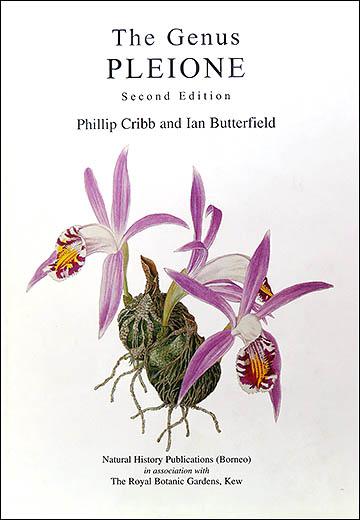
"The Genus Pleione" by Phillip Cribb & Ian Butterfield (Second Edition)
Published in 1999 by Natural History Publications in association with the Royal Botanic Gardens, Kew. ISBN 983-812-040-5 (The first edition was published in 1988) Hardback only. Phillip Cribb was deputy Keeper of the Herbarium and Curator of the Orchid Herbarium at the Royal Botanic Gardens, Kew from 1974 until he retired in 2006. Ian Butterfield is a nurseryman who is well known as the main breeder and supplier of Pleione. |
The monograph contains chapters on History, Morphology, Cytology, Ecology & Conservation, Cultivation, Hybridisation, Growing Pleiones from Seed and Taxonomy. There is also a list with descriptions of registered hybrids and of those pleiones that have received awards. There are 18 colour plates of botanical paintings and 67 colour photographs of species and hybrids, as well as distribution maps.
This book is sadly now out of print but used copies can still be found by searching online. It was originally priced around £33 Sterling. A new, 3rd edition is a future possibility.
This book is sadly now out of print but used copies can still be found by searching online. It was originally priced around £33 Sterling. A new, 3rd edition is a future possibility.
|
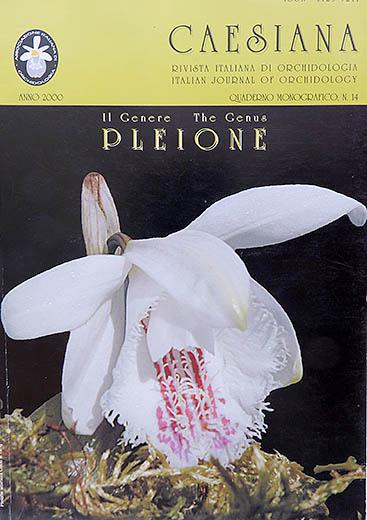
"The Genus Pleione" by Gianantonio Torelli
STILL AVAILABLE! This monograph is written in both Italian and English. It contains chapters on History, morphology, Cultivation, Taxonomy, The Species and Hybrids. It also has lists of the registered hybrids. There are 37 colour photographs (all of them of species, no hybrids) as well as line drawings, distribution maps and climate data tables. This book was published in 2000 as a special edition of Caesiana, the Italian Journal of Orchidology. It can be purchased from Franco Bruno. The author also has an informative website. |
|
The respective authors of the above two books have some disagreements over taxonomy and it is well worth reading both to get the wider picture. Both however are now quite dated when it comes to the taxonomy so let's hope for new updated editions. Dr. Torelli's book has more detailed suggestions for cultivation, while Cribb's book has more and useful information on hybrids. The colour rendition of the photographs is much better in Torelli's book - in the other, the colours of the hybrids in particular have come out far too saturated.
|
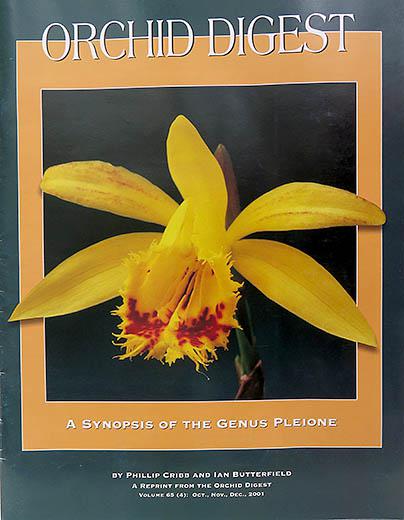
"A Synopsis of The Genus Pleione" by Phillip Cribb & Ian Butterfield
STILL AVAILABLE! This is a special issue of " The Orchid Digest", reprinted from an original article in Volume 65 (4): Oct to Dec 2001. It has some revisions to the taxonomy presented in their book (see taxonomy) and 58 colour photos (mainly different to those in the book), plus some stereo pairs. Much of the remaining information is (verbatim) from the book. You can order this, price $5 plus postage, from The Orchid Digest online shop. |
|
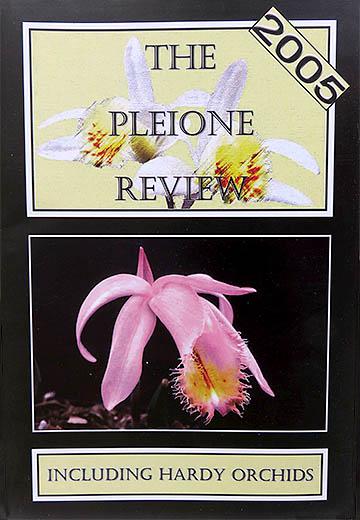
"The Pleione Review" (including Hardy Orchids)
(Prior to 2002 the title of this publication was "The National Pleione Report"). This was a magazine published annually from 1988 to 2005, firstly by Peter Bradbury & then by myself. It contained articles by growers both amateur & professional, as well as botanists and was a 'must have' for all Pleione enthusiasts. Though the emphasis was on Pleione, there were also some articles on hardy orchids. The magazine is no longer published but the back issues are now available online |
|
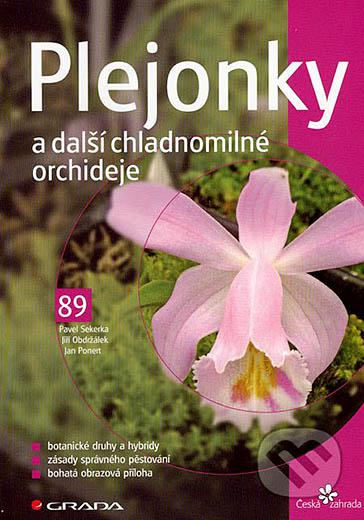
|
"Plejonky a další chladnomilné orchideje" (Pleione and other cold-orchids) by Pavel
Sekerka, Jiří Obdržálek and Jan Ponert
Published by Grada in 2007. Written in Slovak, the Czech language, this book describes Pleione & indicates they are intended primarily for cultivation in greenhouses, frames and cool rooms. It also describes some species of Calanthe, Malaxis, Liparis, Ophrys, Orchis, Disa, Satyrium, Dendrobium, Paphilopedilum and a few others. Each plant is given a description, origin and the possibility of growing in Czech conditions. Out of print. |
There is one further article worth mentioning, yet again by Cribb & Butterfield. This is "Little known & Confused Species of Pleione". This appeared in the September 2001 edition of "The New Plantsman" magazine, published by The Royal Horticultural Society (RHS). It dealt with just those species whose taxonomy had at that time just been revised. This issue is still available from the RHS as a back-issue.
In addition to the publications mentioned, there are also many scientific research papers published relating to Pleione. I will not list these here, but they can be found by searching using Google's Scholar Search.