Cultivation of Pleione - Part 1
1. Where in the world can they be grown?
Pleiones can be grown wherever conditions sufficiently mimic their natural habitat. They come from areas with distinct seasons of Spring, Summer, Autumn and Winter and grow best wherever the average summer temperatures dos not exceed 25 centigrade (though a few odd days up to 30 centigrade is tolerated). In winter, while they are dormant, they need to be kept cold but just frost-free. A range between 1 and 5 centigrade is ideal. If need be, small numbers can be kept in a fridge if your winters are usually too warm (you can un-pot them and keep them in the fridge in a paper bag). Within these restraints they may be grown on a windowsill, in a glasshouse or cold frame and may be put outside for those months that are frost-free. In areas with few and gentle frosts they can even be planted in the garden. But most people grow them as pot plants.
Pleiones can be grown wherever conditions sufficiently mimic their natural habitat. They come from areas with distinct seasons of Spring, Summer, Autumn and Winter and grow best wherever the average summer temperatures dos not exceed 25 centigrade (though a few odd days up to 30 centigrade is tolerated). In winter, while they are dormant, they need to be kept cold but just frost-free. A range between 1 and 5 centigrade is ideal. If need be, small numbers can be kept in a fridge if your winters are usually too warm (you can un-pot them and keep them in the fridge in a paper bag). Within these restraints they may be grown on a windowsill, in a glasshouse or cold frame and may be put outside for those months that are frost-free. In areas with few and gentle frosts they can even be planted in the garden. But most people grow them as pot plants.
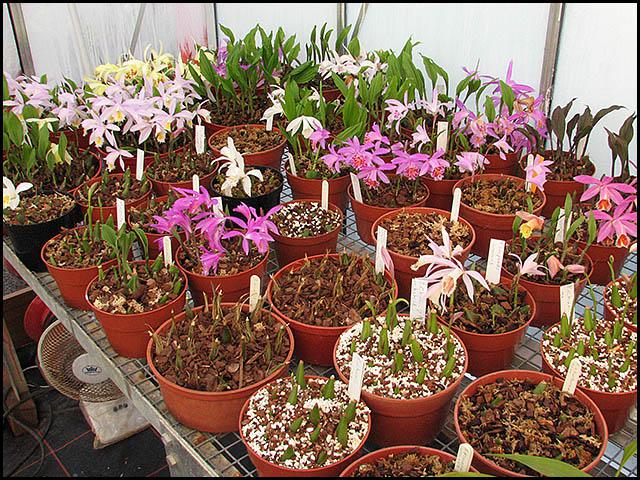
A Pleione collection grown in a glasshouse
2. What kind of containers can be used?
Clay or plastic pots can be used and both have their devotees. Clay pots may need watering more frequently but the evaporation from their surface helps to keep the roots cool and provides humidity around the plants. Plastic pots need less frequent watering, are easier to clean and lighter to use. Many growers use half pots, pans or seed trays, as pleiones are shallow rooting in the wild. In a pot the roots can go much deeper and will easily fill a deep pot but, despite this, my experience is that are still happier in a shallower container. It is probably wise to thoroughly clean and disinfect pots before use.
Clay or plastic pots can be used and both have their devotees. Clay pots may need watering more frequently but the evaporation from their surface helps to keep the roots cool and provides humidity around the plants. Plastic pots need less frequent watering, are easier to clean and lighter to use. Many growers use half pots, pans or seed trays, as pleiones are shallow rooting in the wild. In a pot the roots can go much deeper and will easily fill a deep pot but, despite this, my experience is that are still happier in a shallower container. It is probably wise to thoroughly clean and disinfect pots before use.
3. What kind of potting compost can be used?
Pleiones will grow in a variety of compost mixes, the main requisites being that the mix should be very "open" and free draining. I have used various different mixes in the past, but now I always use a mix of 3 parts bark and 2 parts moss (All "parts" are by volume). The bark can be small to medium grade orchid bark or even a good quality mulching bark. Here in the U.K. I use a product called Melcourt Potting Bark, which is similar to (though not quite as good as) orchid bark in quality. This is what it looks like:
Pleiones will grow in a variety of compost mixes, the main requisites being that the mix should be very "open" and free draining. I have used various different mixes in the past, but now I always use a mix of 3 parts bark and 2 parts moss (All "parts" are by volume). The bark can be small to medium grade orchid bark or even a good quality mulching bark. Here in the U.K. I use a product called Melcourt Potting Bark, which is similar to (though not quite as good as) orchid bark in quality. This is what it looks like:
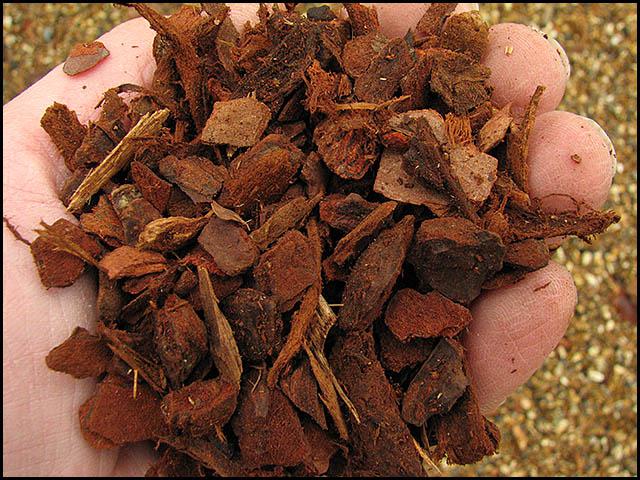
Melcourt potting bark
The moss used can be wood moss or Sphagnum moss (which may be live or dead). I buy bales of dried Sphagnum moss which look like this:
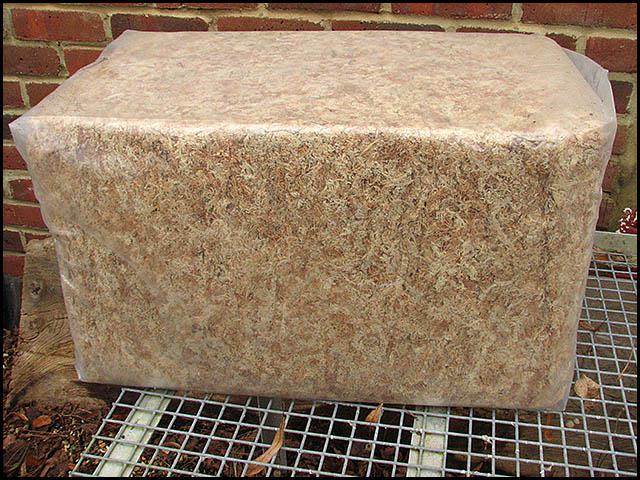
Bale of dried Sphagnum moss
The bales are compressed and need breaking up before use. I find the long strands of moss do not mix easily into the bark and are best cut into shorter lengths of roughly 5 to 7 cm . It is easier to do this if the moss is dampened first. Small amounts can be cut using scissors. A serrated bread knife works well if used on a dampened, compressed handful. Cutting up large quantities by hand takes far too long but putting dampened moss through a garden shredder works quite well and quickly too - an entire bale can be done in about an hour. When ready for use it looks like this:
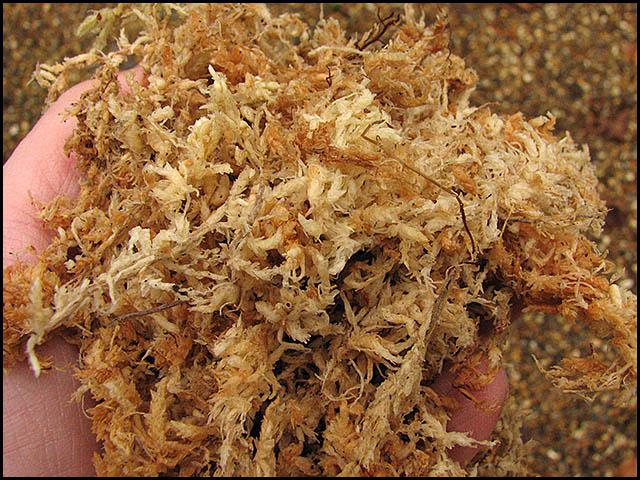
Dampened Sphagnum moss cut into shorter lengths
When the 3 parts bark and 2 parts moss are mixed together to give the final potting mix, it looks like this:
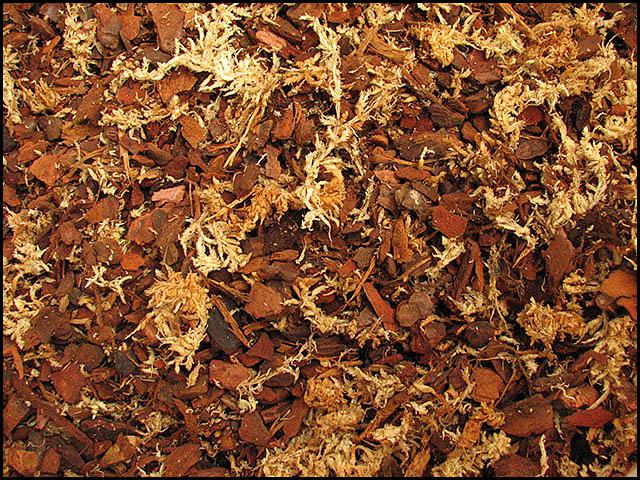
Pleione potting mix ready to use
Many other mixes are suitable - you can use pure wood moss or pure sphagnum, or a mix containing these along with such ingredients as bark, pine needles, leafmould, coarse peat, perlite and others - the main aim is to get a "scrunchy" or spongy, open and free-draining mix. There are as many recipes for mixes as there are growers!